Your electrical panel is the command center of your home. It receives power from the utility and distributes it to every circuit — lights, outlets, appliances, HVAC, and increasingly, EV chargers and heat pumps. Most homes built before 1990 were wired with 100-amp service, which was fine when the biggest electrical loads were a window AC unit and a washer-dryer. That world no longer exists. A Level 2 EV charger alone draws 48 amps continuously. A heat pump with electric backup heat needs 30–50 amps. Add a home office, smart appliances, and an induction range, and a 100-amp panel is simply not sufficient. The question is not always whether to upgrade — often it's when, which brand of panel to choose, what the process involves, and what the full cost will be. This guide covers all of it, including the IRA tax credit that can offset up to $600 of your upgrade cost.
7 Signs Your Electrical Panel Needs to Be Upgraded
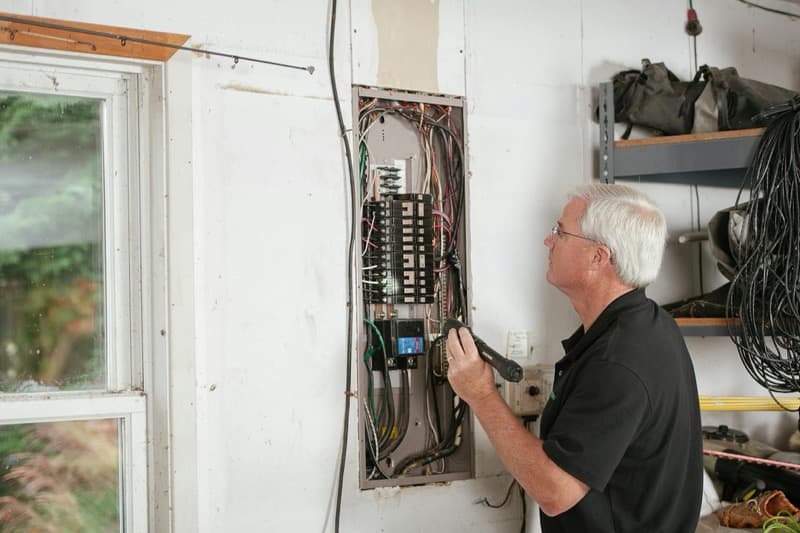
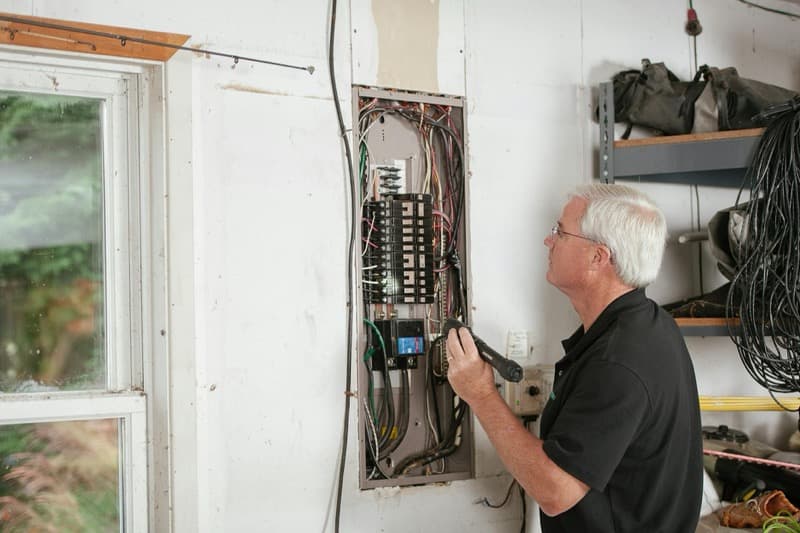
Not every panel problem is obvious. Some signs are subtle until they become dangerous. Here are the seven most common indicators that your panel has reached the end of its useful life or its capacity limits. First, circuit breakers that trip frequently on circuits that are not overloaded — if a breaker trips for the kitchen or master bedroom even when you are not running multiple high-draw appliances, the breaker itself may be failing. Second, lights flickering or dimming when appliances start up, particularly the refrigerator, air conditioner, or washer — this indicates voltage sag caused by inadequate amperage capacity. Third, a burning smell or scorch marks anywhere near the panel, which is a fire hazard that requires immediate attention. Fourth, the panel is 30 years old or older — breakers degrade over time and may fail to trip during overloads, which is their primary safety function. Fifth, you have a recalled panel brand (Federal Pacific, Zinsco, or Pushmatic — detailed below). Sixth, you are adding a major new load: EV charger, heat pump, hot tub, home addition, or solar system with battery backup. Seventh, your panel still uses fuses instead of circuit breakers — fuse panels are safe when properly maintained but limited to 60 or 100 amps and incompatible with modern loads.
Recalled and Dangerous Panel Brands
Three panel brands have documented safety defects that justify replacement regardless of age or apparent function. Federal Pacific Electric (FPE) Stab-Lok panels: manufactured from the 1950s through the 1980s, these panels have a documented failure rate for their breakers — they fail to trip during overloads, which is the one thing a circuit breaker must do. Studies by the Consumer Product Safety Commission found that FPE Stab-Lok breakers failed to trip in 51.3% of test cases. An estimated 28 million FPE panels are still in service. If your panel has the Stab-Lok name on the breakers or a red stripe on the panel door, it is an FPE panel. Zinsco panels (also sold as Sylvania GTE after acquisition): similar failure mechanism, with breakers that can fail to trip AND can weld themselves in the closed position after a fault, creating a permanent hazard. Zinsco panels are identifiable by pastel-colored breakers (blue, red, green). Pushmatic panels: less dangerous than FPE or Zinsco but no longer serviceable since replacement parts are no longer manufactured. A failed Pushmatic breaker cannot be replaced with a standard substitute. Many home insurers refuse to write policies on homes with FPE or Zinsco panels, or will cancel existing policies within 30–90 days of identifying them.
What a Panel Upgrade Actually Costs
The total cost of a 100-amp to 200-amp panel upgrade ranges from $1,500 to $4,500 installed across most US markets, with the national average around $2,800. Here is where that money goes. The panel itself (the electrical box and circuit breakers): $400–$800 for a quality unit from Square D (QO line), Eaton (BR line), or Leviton. Labor for the electrician: typically 4–8 hours, billed at $75–$150 per hour depending on market. The permit fee: $150–$500 depending on your city and state — this is not optional. The utility disconnect fee: most utilities charge $100–$400 to temporarily disconnect service from the street so the electrician can safely work on the service entrance. In older homes, the service entrance cable (the wire running from the meter to the panel) may also need replacement, adding $500–$1,200. High-cost markets (New York City, San Francisco, Chicago, Seattle) run closer to $3,500–$5,500 for the same scope of work. If you are also upgrading from 200-amp to 400-amp service for a whole-home electrification project, costs jump to $5,000–$10,000 or more depending on whether the utility needs to upgrade the transformer.
- 100A → 200A panel upgrade (standard): $1,500–$4,500 installed
- 200A → 400A upgrade (whole-home electrification): $5,000–$10,000+
- Panel replacement only (same amperage, defective brand): $1,200–$3,000
- Sub-panel addition (when main panel cannot be upgraded): $800–$2,500
- Service entrance cable replacement (if needed): $500–$1,200 additional
- Permit fees: $150–$500 depending on jurisdiction
- Utility disconnect fee: $100–$400
The IRA Tax Credit for Panel Upgrades
The Inflation Reduction Act (IRA), signed in August 2022, provides a 30% federal tax credit for electrical panel upgrades under Section 25C of the IRS code, up to a maximum of $600 per year for the panel upgrade component. The key condition: the panel upgrade must be done in connection with a qualifying energy efficiency improvement — an EV charger installation, a heat pump, or other 25C-eligible equipment. A standalone panel upgrade does not qualify. However, if you are adding an EV charger (which qualifies for its own 30% credit up to $1,000 under Section 30C) at the same time, both the panel and the charger qualify for separate credits. This means a $2,000 panel upgrade plus a $1,200 EV charger installation could yield $600 (panel) plus $360 (charger) in federal tax credits, reducing your net out-of-pocket to approximately $2,240. Additional utility rebates are also available in many states — check the DSIRE database (dsireusa.org) for your state. File IRS Form 5695 to claim residential energy credits. These are non-refundable credits, meaning they reduce your tax liability dollar-for-dollar but do not generate a refund if your liability is below the credit amount.
IRA Stacking Tip: A panel upgrade done concurrently with a heat pump qualifies for both the $600 panel credit AND the $2,000 heat pump credit under Section 25C. Combined with Section 30C for an EV charger, you can stack up to $3,600 in federal credits on a single home electrification project.
The Permit Process: What to Expect
A panel upgrade requires a permit in every US jurisdiction. This is non-negotiable and protects you in multiple ways: the inspection ensures the work is done correctly, the permit creates a legal record that the work was done, and unpermitted electrical work can void your homeowner insurance and create problems when you sell the home. The typical permit process works like this: your licensed electrician applies for the permit (they do this, not you), which takes 1–5 business days in most cities. The utility schedules a disconnect, which can take 1–3 weeks in busy seasons. The work is completed in a single day in most cases. A city inspector visits, usually within 1–3 business days of the work being completed. If the installation passes inspection, the permit is closed out. Do not use an electrician who offers to skip the permit — this is a red flag that should end the conversation immediately. The permit cost is always worth it.
Choosing the Right Panel Brand
When upgrading, your electrician will recommend a panel brand. The two most widely recommended residential brands are Square D QO series and Eaton BR series. Both have well-documented reliability records, widely available replacement breakers, and broad compatibility with AFCI and GFCI breakers required by modern electrical code. Avoid budget import brands available at big-box stores for significantly less — the savings are not worth the long-term parts availability and reliability risk. Ask your electrician which brand they prefer and why — a good electrician has a strong opinion and a clear reason. Siemens and Leviton also make quality residential panels. Most electricians stock Square D or Eaton and can give you a faster installation turnaround with their preferred brand.